Why Are Greyhounds So Fast? The Science of the Sprint
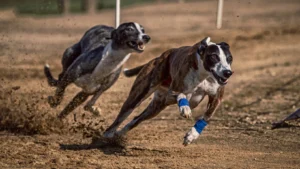
A greyhound can hit roughly 70 kilometres per hour and reach that speed in just a few strides — quicker off the mark than most cars. Only the cheetah is faster over land among the animals we know well, and the greyhound sustains its pace far longer. So what makes this gentle, sofa-loving breed the fastest dog on earth? The answer is a masterclass in evolutionary engineering, and understanding it makes watching a hound run even more of a privilege.
Built like a sprinter, from nose to tail
Everything about a sighthound’s body is optimised for speed. The deep chest houses an oversized heart and enormous lungs, delivering the oxygen a sprint demands. The narrow, aerodynamic skull and lean frame cut drag. The long, fine legs act like levers, covering huge distances with each stride. And the light, muscular body keeps the power-to-weight ratio absurdly high — all engine, no ballast.
Muscle composition plays a starring role. Greyhounds carry a very high proportion of fast-twitch muscle fibres, the kind built for explosive, powerful contractions rather than endurance. It is the canine equivalent of a 100-metre sprinter’s physiology: devastating over a short distance, quick to tire. That is exactly why a greyhound can obliterate a sprint and then sleep for the rest of the afternoon — the body is specialised for the burst, not the slog.
The double-suspension gallop
The real magic is in how a greyhound moves. Sighthounds use a “double-suspension gallop,” a running style in which the body is fully airborne twice in every stride — once when the legs are gathered underneath and again when they are fully extended. In effect, the dog is flying for more of each stride than it is touching the ground.
This is possible because of an extraordinarily flexible spine. As the hound runs, its back flexes and extends like a drawn bow, storing and releasing energy with every cycle. The spine curls to bring the back legs far forward under the body, then snaps straight to fling them back, dramatically lengthening the stride. Combine that whip-like spine with long legs and a rotating shoulder blade, and you get a stride length that eats ground at a rate no other dog can match.
| Animal | Top speed | Sprint style |
|---|---|---|
| Cheetah | ~110 km/h | Short explosive burst |
| Racehorse | ~70 km/h | Sustained gallop |
| Greyhound | ~72 km/h | Double-suspension gallop |
| Usain Bolt | ~44 km/h | Human peak sprint |
Big heart, big lungs
A deep chest houses an oversized heart and huge lungs, feeding oxygen to the muscles during an all-out sprint.
Fast-twitch muscle
A high share of fast-twitch fibres delivers explosive power — brilliant for the burst, quick to tire.
A spring for a spine
The flexible back flexes and extends like a bow, storing energy and stretching every stride to its limit.
Bred for the chase over thousands of years
None of this happened by accident. Sighthounds are among the most ancient dog types, depicted in art thousands of years old and bred across cultures specifically to hunt fast-moving prey by sight. Generation after generation, the fastest and most successful hunters were the ones that reproduced, refining the template toward pure speed. The modern greyhound is the endpoint of that long selective process — a dog shaped, quite literally, for running.
That heritage also explains the greyhound’s famous prey drive. The instinct to chase anything small and fast is hard-wired, which is why secure spaces and reliable recall matter so much for pet hounds. The same biology that makes them breathtaking to watch also means a squirrel can undo a lot of training in a heartbeat.
How greyhound speed compares
Numbers make the greyhound’s ability easier to appreciate. At roughly 70 km/h, a greyhound is faster than a champion human sprinter by a factor of two and quicker off the mark than most family cars. Among land animals, only the cheetah clearly beats it for outright top speed, and the cheetah pays for that speed by overheating within seconds — the greyhound can sustain a hard run for noticeably longer. Compared with other dogs, nothing comes close over a flat sprint: breeds like the saluki are superb over distance and endurance, and herding breeds are more agile through turns, but for pure straight-line velocity the greyhound stands alone.
What is striking is how efficiently the greyhound reaches those speeds. Thanks to its long stride and spring-loaded spine, it accelerates from a standstill to near-top-speed in just a few strides, which is why a garden sprint after a squirrel looks so explosive. That combination of blistering acceleration and high top speed, in a dog that then naps for eighteen hours, is what makes the breed so remarkable.
Whippets and the wider sighthound family
The greyhound may be the record-holder, but the whole sighthound family is built for speed. Whippets, at a fraction of the size, are astonishingly quick — often cited around 55–60 km/h — and share the identical double-suspension gallop and sprinter’s physiology. Salukis and other Middle Eastern hounds were bred for stamina as much as speed, able to course across desert distances that would exhaust a greyhound. Italian greyhounds, though bred as companions, still carry the same spring-loaded design in miniature, which is why an iggy tearing around a garden looks exactly like a greyhound viewed through the wrong end of a telescope.
All of them rely on the same core adaptations: the deep chest, the flexible spine, the long legs and the high proportion of fast-twitch muscle. Nature arrived at one brilliant blueprint for a running dog and then simply scaled it up and down. That is why the family resemblance is so strong, and why watching any sighthound run reveals the same hypnotic, flying gait.
Nature, plus a little conditioning
Genetics set the ceiling, but condition determines how close a dog gets to it. Racing greyhounds are finely tuned athletes, kept lean and muscular through careful diet and exercise, which is why they can perform at the very top of the breed’s ability. A pet greyhound lounging on the sofa carries the same fundamental machinery but is not in race condition — and that is completely fine. A healthy weight, gentle regular exercise and the occasional safe sprint keep a pet hound fit and happy without any need to train like a competitor.
It is worth remembering that speed of this kind is genetic, not learned. You cannot train an ordinary dog into a greyhound’s velocity, and you do not need to train a greyhound to be fast — it simply is. What conditioning affects is stamina, muscle tone and healthy weight, all of which support the dog’s wellbeing far more than its top speed. For most owners, the goal is a healthy, contented hound, not a faster one.
Watching a sighthound run — safely
Seeing a greyhound or whippet open up into a full gallop is a genuine thrill, but it needs to happen safely. Because their prey drive is so strong and their speed so extreme, an off-lead sprint in an unsecured area is risky — a hound can be over the horizon before you finish calling its name. The safest options are fully enclosed fields (increasingly available to hire by the hour for exactly this purpose) or a long training line in open space that lets the dog stretch out without the risk of a bolt. Warm up gently, avoid hard sprints on slippery or very hard surfaces that can injure joints, and let older or unfit dogs build up slowly.
Do it right and you are rewarded with one of the finest sights in the dog world: millions of years of evolution and centuries of breeding, expressed in a few seconds of pure, flying motion — before the athlete in question trots back, flops down, and resumes being the world’s most elegant couch potato.
Dogs in full stride We draw sighthounds the way they move — lean, fast and mid-sprint — by hand, on premium cotton.
Fast, then fabulously lazy
Here is the paradox that surprises every new owner: the fastest dog on the planet is also one of the laziest. Because their bodies are built for short, intense bursts rather than sustained effort, greyhounds and whippets need surprisingly little exercise — a couple of chances to properly stretch out and sprint, plus gentle walks, and they are content to sleep eighteen hours a day. They are sprinters, not marathoners, and their downtime is as extreme as their speed.
It is this contradiction — explosive athlete one moment, boneless couch ornament the next — that makes sighthounds so endlessly charming. Watching one unfold into a full double-suspension gallop across a field is watching millions of years of evolution do exactly what it was designed to do. And then watching the same dog trip over its own legs on the way to the sofa is a reminder that they are, gloriously, still just dogs.
Key takeaways
- The greyhound’s speed comes from a flexible spine and a double-suspension gallop — all four feet leave the ground twice per stride.
- A huge heart, light frame and long legs let it hit top speed in just a few strides.
- It is one of the fastest land animals on Earth, second only to the cheetah over short distances.
- Despite this, greyhounds are sprinters, not marathoners — a few short bursts and they nap for hours.
Frequently asked questions
How fast can a greyhound actually run?
Around 70 km/h (roughly 45 mph) at full sprint, reached within a few strides. That makes the greyhound the fastest dog breed and one of the fastest land animals over short distances.
Are whippets as fast as greyhounds?
Whippets are astonishingly fast for their size — often cited around 55–60 km/h — but the larger greyhound edges them out at the top end. Both share the same double-suspension gallop and sprinter’s build.
If they are so fast, why do they need so little exercise?
Because they are built for short, explosive bursts rather than endurance. A few proper sprints and some gentle walks satisfy them; long, steady jogging actually suits them far less than it suits many other breeds.
Can any dog beat a greyhound in a sprint?
Over a short, straight sprint, essentially no domestic breed out-runs a fit greyhound. Some breeds are more agile over twists and turns, but for flat-out top speed the greyhound is in a class of its own.
Capturing the sprint
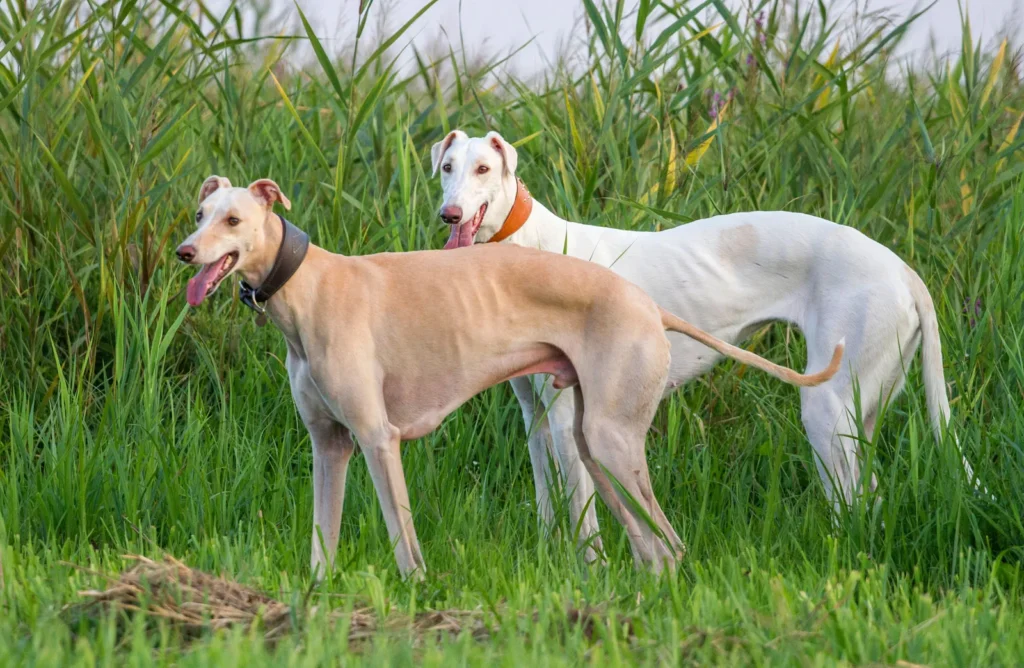
A greyhound at full stretch is one of the finest sights in the natural world.
That flying, spring-loaded gait is exactly what we try to capture in our artwork. It is far more interesting to draw a hound mid-sprint — legs gathered, spine flexed, ears pinned back — than another static dog sitting politely, because the sprint is where a sighthound becomes most itself. Every design in our greyhound & whippet collection starts as a hand-drawn line that tries to hold onto that sense of speed, whether it is a full-tilt gallop or the split-second before the launch. If you want to wear the science you have just read about, the whole range of tees is built around exactly this: dogs in motion, drawn by hand, on premium cotton.
There is something fitting about carrying a running hound on a t-shirt while the real thing sleeps for eighteen hours a day. The design remembers what the dog was built to do, even when the dog itself is fully committed to being a cushion. For the sighthound obsessed, it is also a neat conversation starter — plenty of people have no idea their affectionate, lazy companion is quietly one of the fastest animals on the planet, and a good print invites exactly that surprised double-take. It makes a thoughtful pick from our dog lover gifts for the greyhound or whippet person who appreciates the athlete hiding under all that laziness.
It is worth pausing on just how unlikely all of this is. Evolution rarely produces specialists this extreme, and rarer still does it wrap one in a temperament so mild that the same animal capable of 70 km/h is also perfectly happy doing nothing at all for most of its life. The greyhound is a genuine paradox made flesh — a peak athlete with the daily ambition of a house cat — and understanding the biology behind the speed only deepens the affection most owners already feel. Once you have watched a hound turn a garden into a racetrack and then request a blanket, the couch-potato reputation and the world-record speed stop feeling contradictory and start feeling like two halves of the same wonderful, ridiculous dog.
So the next time a greyhound rockets past you and then collapses dramatically onto the nearest cushion, you will know exactly what you are looking at: a deep chest, a spring-loaded spine, fast-twitch muscle and thousands of years of breeding, all wrapped up in the world’s most elegant couch potato.