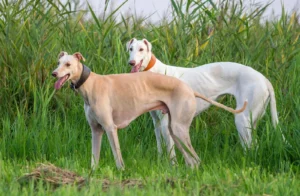
Greyhound vs Whippet vs Italian Greyhound: A Sighthound Size & Personality Guide
Ask three sighthound owners to tell a greyhound, a whippet and an Italian greyhound apart and you might get three slightly different answers. To the untrained eye they can look like the same dog set to three different zoom levels — the same deep chest, tucked waist, long legs and impossibly graceful curve. But spend any time around them and the differences become obvious, from size and speed to temperament and the amount of blanket-burrowing you should expect. This guide walks through how to tell the three most popular sighthounds apart, what living with each is really like, and how to pick the breed (or the tee) that fits your life.
The quick version: three sizes of the same beautiful idea
All three breeds belong to the sighthound family — dogs bred over centuries to hunt by sight and speed rather than scent. That shared job explains the shared silhouette: aerodynamic head, flexible spine, huge lungs and a long stride built for the chase. The headline difference is size. Greyhounds are the tallest and heaviest, whippets are the mid-size all-rounder, and Italian greyhounds are the delicate miniature. Everything else — energy, prey drive, sensitivity — flows from that same template scaled up or down.
Greyhounds: the gentle giants
Standing 68–76 cm at the shoulder and weighing 27–40 kg, greyhounds are surprisingly large in person. What surprises new owners even more is how little they do with all that size. Despite being the fastest dog breed on the planet — capable of roughly 70 km/h — the greyhound is a champion napper, content with two short sprints and eighteen hours of sofa duty. They are quiet, sensitive, and famously described as “45 mph couch potatoes.” Many are retired racers looking for a soft landing, which makes them one of the most rewarding rescue breeds you can bring home.
Whippets: the pocket rocket
The whippet is the sighthound most people fall for as a first hound. At 44–51 cm and 9–19 kg, it is big enough to feel like a proper dog and small enough to scoop up when it inevitably decides your lap is the best place in the house. Whippets are affectionate, velcro-close and playful, with a slightly higher energy ceiling than greyhounds. Give them a daily gallop in a safe space and they will match your calm indoors for the rest of the day.
Italian greyhounds: the delicate companion
The Italian greyhound (or “iggy”) is the smallest of the group at 33–38 cm and 3–5 kg. Bred as a companion rather than a courser, the iggy is all elegance and affection, with fine bones that demand gentle handling. They are clever, sensitive and deeply attached to their people — a shadow you will find under the nearest blanket the moment the temperature drops.
| Trait | Greyhound | Whippet | Italian greyhound |
|---|---|---|---|
| Height | 68–76 cm | 44–51 cm | 33–38 cm |
| Weight | 27–40 kg | 7–14 kg | 3–5 kg |
| Top speed | Up to 72 km/h | Up to 55 km/h | Up to 40 km/h |
| Energy level | Low–moderate | Moderate | Moderate |
| Best for | Calm homes, sofa lovers | Active households | Apartment living |
Greyhound
68–76 cm · 27–40 kg · the fastest dog alive · a serene, sensitive nap champion, often a retired racer.
Whippet
44–51 cm · 9–19 kg · the mid-size all-rounder · playful, velcro-close and endlessly affectionate.
Italian Greyhound
33–38 cm · 3–5 kg · the delicate companion · clever, sensitive and permanently under a blanket.
How to tell them apart at a glance
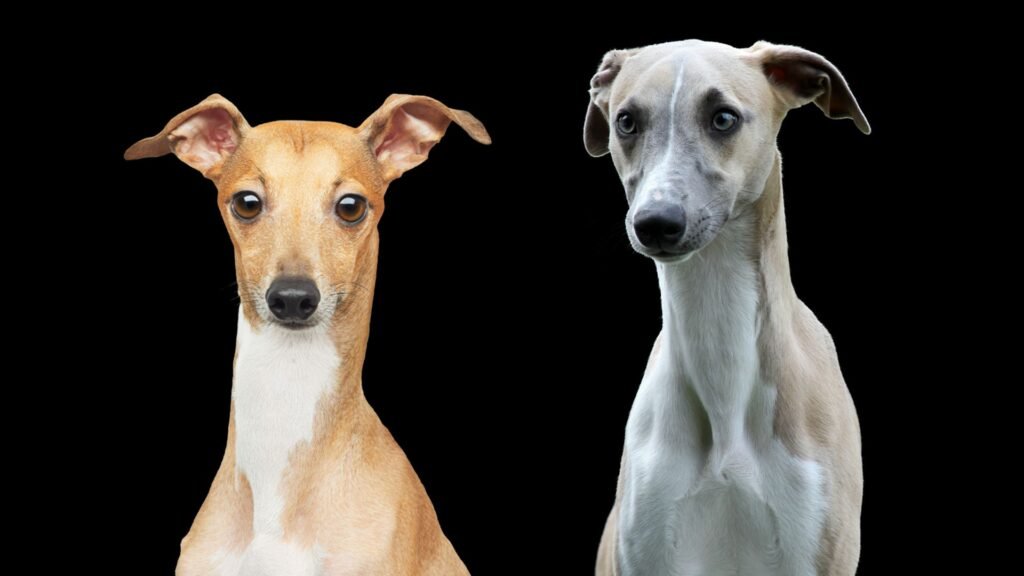
Size is the fastest clue, but it is not always reliable — a large whippet and a small greyhound can overlap. When you cannot rely on scale, look at proportion and detail. The greyhound has a longer, more substantial head and a heavier bone structure; the whippet is a scaled-down, finer version of the same lines; the iggy has a tiny, arched frame and a high-stepping, almost prancing gait. Ears help too: all three carry small rose-shaped ears that fold back when relaxed and lift when curious, but the iggy’s look comically large against its little head.
Coat and colour are shared rather than distinguishing. All three come in a huge range — black, blue, fawn, brindle, white and every combination — with the same short, low-maintenance coat that sheds little and needs almost no grooming. If you are looking at a photo and genuinely cannot tell, size and head shape are your best bets; everything else is a family resemblance.
Living with a sighthound: what all three share
Whichever size you choose, some things stay constant. Sighthounds feel the cold — a short single coat and very little body fat means jumpers and blankets are not a fashion statement but a genuine need. They have a strong prey drive triggered by fast movement, so a secure garden and a reliable recall (or a long line) matter. They are sensitive souls who do not respond to harsh training, thriving instead on patience, routine and gentle encouragement. And they are quieter than almost any other breed of comparable size, which makes them brilliant flat-mates.
Exercise needs are lower than the athletic build suggests. A couple of short walks plus the chance to properly stretch out and sprint a few times a week keeps a sighthound happy. What they cannot do is jog for an hour at a steady pace — they are sprinters, not marathon runners, built for explosive speed followed by long recovery.
Temperament: the real day-to-day differences
Size gets the headlines, but temperament is where owners feel the difference. Greyhounds are the most placid of the three — serene, a little aloof with strangers at first, and almost aggressively relaxed once they trust you. They tend to take life at their own gentle pace and are rarely needy. Whippets sit a notch higher on the affection and energy scale: they are the clingiest of the family, often wanting physical contact at all times, and they retain a playful, kittenish streak well into adulthood. Italian greyhounds combine whippet-level devotion with an extra dose of sensitivity; they bond intensely, dislike being left alone, and can be genuinely fragile emotionally as well as physically, so they thrive in calm, attentive homes.
Trainability follows a similar pattern across all three. None of them respond to harsh methods — a raised voice shuts a sensitive sighthound down rather than motivating it. All do best with patient, reward-based training, short sessions and plenty of consistency. Housetraining a retired racing greyhound sometimes takes a little longer simply because the dog is learning the concept of a “home” for the first time, while whippets and iggies raised in domestic settings usually pick things up quickly. Recall is the shared challenge: the same prey drive that makes them breathtaking to watch means a fast-moving squirrel can override training in an instant, so secure spaces matter for every size.
Health, lifespan and everyday care
One of the joys of the sighthound family is how little maintenance they require. All three have short, fine coats that shed modestly and need almost no grooming — an occasional wipe-down and a nail trim is usually the extent of it. Bathing is rarely needed, as they lack the oily coat that gives many breeds a “doggy” smell. That low-maintenance coat is part of what makes them such easy house dogs.
Lifespan is generally good. Whippets and Italian greyhounds often live 12–15 years, while greyhounds typically reach 10–13. Each breed has a few health considerations worth knowing: greyhounds can be sensitive to certain anaesthetics and have unusual blood values that a sighthound-savvy vet will understand; Italian greyhounds have delicate legs that can fracture from an awkward jump, so managing their environment matters; and all three feel the cold acutely and can be prone to dental issues, making regular tooth care worthwhile. None of this is cause for alarm — it is simply the practical knowledge that comes with the territory, and reputable breeders and rescues will talk you through it.
Which one suits families, flats and other pets?
For families with children, temperament and robustness both matter. Greyhounds are often wonderful with respectful older children thanks to their patience and size, though their need for calm means very boisterous toddlers are not an ideal match. Whippets are playful and sturdy enough for gentle family life. Italian greyhounds, being so fragile, are usually better suited to adult-only or older-child households where an accidental knock is less likely. In flats, all three excel because they are quiet and sleep for most of the day; the iggy’s compact size and the greyhound’s calm both make them surprisingly good apartment dogs, provided you can meet their need to stretch out and sprint somewhere safe.
Wear your favourite hound Original, hand-drawn greyhound and whippet t-shirts on premium oversized cotton.
Which sighthound is right for you?
If you have the space and a soft spot for rescue, a greyhound offers the most dog for the least effort — huge, gentle and low-energy. If you want a slightly more playful companion that still loves a couch, the whippet is the classic first hound. And if you live small, feel the cold, and want a devoted shadow, the Italian greyhound is hard to beat, provided you are comfortable with a fragile little body that needs careful handling. There is no wrong answer; there is only the size of sighthound that fits your home.
Of course, you do not have to choose just one to celebrate them. A hand-drawn tee lets you carry your favourite hound with you whether or not one is currently asleep on your feet — and it makes a thoughtful gift for the sighthound person in your life.
Key takeaways
- All three share one silhouette but differ hugely in size — from a 4 kg Italian greyhound to a 40 kg greyhound.
- Greyhounds are the fastest and, surprisingly, the laziest at home; whippets keep a little more energy.
- Italian greyhounds suit apartments best; greyhounds need a soft bed more than a big garden.
- Whatever the size, they are quiet, affectionate and sleep most of the day.
Frequently asked questions
Is a whippet just a small greyhound?
Not exactly. They are separate breeds with a shared ancestry and silhouette. Whippets were developed as smaller coursing and racing dogs, so while they look like a scaled-down greyhound, they have their own standard, temperament and slightly higher energy level.
Which sighthound is best for apartments?
All three adapt beautifully to flats because they are quiet and sleep most of the day. Greyhounds and whippets need access to a safe space to sprint a few times a week; Italian greyhounds are the most compact and the easiest to keep warm indoors.
Do sighthounds really need to wear coats?
Yes. Their thin single coat and low body fat mean they genuinely feel the cold, so a jumper for chilly walks and a blanket at home are practical, not pampering — especially for Italian greyhounds.
Are greyhounds good with cats and small pets?
It varies by individual. Many retired racers live happily with cats after a careful introduction, while others have a strong prey drive. Reputable rescues cat-test their dogs and will match you with a hound suited to your household.
A shared history worth celebrating
Part of what makes the sighthound family so special is how deep its roots run. These are among the most ancient of all dog types, appearing in art and artefacts thousands of years old, from the tombs of the ancient world to the tapestries of medieval Europe. For most of that history they were prized above almost any other animal — bred, painted and even written about by royalty precisely because their speed and elegance seemed to belong to a higher order of creature. When you look at a greyhound, a whippet or an Italian greyhound today, you are looking at a living link to that long lineage, essentially unchanged in silhouette across the centuries.
That heritage is a big reason sighthounds inspire so much creativity. Their clean, dramatic lines are a gift to an illustrator: a single continuous stroke can capture a whole running greyhound in a way few other breeds allow. It is why artists keep returning to them, and why a hand-drawn sighthound on a t-shirt feels less like novelty merch and more like a small tribute to an animal people have admired for millennia. Owning and wearing that art is a way of joining a very old appreciation society — one that has always understood that these dogs are as beautiful standing still as they are at full stretch.
Understanding the differences between the three breeds, then, is not just practical trivia for choosing a pet. It is a way of appreciating three variations on one of the oldest and most admired designs in the animal kingdom — and of recognising the specific hound that has stolen your heart, whether it is currently sprinting across a field or snoring upside down on your sofa.
Whichever hound has claimed you, there is something satisfying about carrying its likeness with you. Our hand-drawn greyhound & whippet tees celebrate the whole family, from the towering greyhound to the pocket-sized whippet, and the full collection of tees has a design for every kind of sighthound devotion. If you are buying for the sighthound person in your life rather than yourself, the same illustrations make characterful dog lover gifts — a small, wearable way to fly the flag for the breed you cannot stop talking about, and a reliable hit with anyone who has ever been out-stubborned by a whippet at bedtime.
However you like your sighthounds — supersized, mid-size or miniature — they are all variations on the same wonderful theme: fast, silly, affectionate and impossible to forget. Learn the sizes, respect the shared quirks, and you will never mistake one for the other again.